
Metal Fabrication ERP Built for How Fab Shops Actually Run
You are running the same parts for the same customers every week. You should know your true cost per piece, your actual yield, and where every constraint is. Most shops do not. OnRamp connects every part of your operation so your floor runs on real data, not memory, whiteboards, and end-of-shift guesses.
OnRamp was built inside a fabricated metals manufacturer. We know what running a fab shop looks like.
What Fabricated Metals Shops Are Dealing With
Most fab shops are not struggling because of bad people or bad equipment. The real problem is that the operation runs on disconnected tools. The line runs every day, but yield, run rate, and changeover data live in a supervisor’s notebook. You are shipping the same part to the same OEM customer month after month and still do not know your true cost per piece. When margin erodes, it happens slowly, across thousands of identical parts, and nobody sees it until it shows up in the accounting report.
For shops running a mix of high-volume releases and custom jobs, the problem compounds. Scheduling lives in a spreadsheet, or in one person’s head. The shop floor runs on paper travelers nobody trusts. Accounting sits in one place, inventory sits somewhere else, and neither matches what production is doing. The information exists. It never arrives where it needs to be, when it needs to be there.
Here is what that looks like day to day:
- The line runs at less than full capacity and nobody knows exactly why
- Yield varies run to run on the same part, but scrap data arrives too late to act on it
- Changeover time is estimated, not measured, so scheduling assumptions are always slightly wrong
- The schedule blows up every time a hot job arrives, and there is no fast way to see what it displaces
- Material is “somewhere in the shop” until production needs it. Then it is not there.
- Customers call to ask where their order is, and the answer requires walking the floor
- Engineering changes arrive mid-run; operators find out late or not at all
- One planner holds all the production knowledge. When they are out, the shop stalls.
If any of those statements describe a real conversation you have had in the last 30 days, you are in the right place.
From the Line to the Ledger: How OnRamp Runs a Fab Shop
Most fabrication shop ERP solutions are collections of modules held together by integrations someone else has to manage. When the schedule changes, someone updates a spreadsheet. When a job ships, someone exports to accounting. Every handoff between tools is a place where information gets delayed or lost.
Whether your shop runs high-volume releases against customer blankets, make-to-order jobs, or both, the underlying problem is the same: data that arrives too late to act on. A repetitive manufacturer losing yield on a high-run part needs to know about it at the machine, not at the end of the shift. A job shop with a hot job needs to see the schedule impact before committing to a due date, not after.
OnRamp works differently. Quoting, scheduling, inventory, shop floor execution, quality, maintenance, shipping, and accounting are all built on one codebase and one data model. When something moves in one part of your operation, every other part knows it immediately. No sync jobs. No manual exports. No gaps to manage.
Here is what that looks like in a fabricated metals shop:
Quoting tied to real cost data: Quotes are built from actual labor rates, material costs, and routing times. Not estimates pulled from memory. When a quote converts to a sales order, the work order is structured and ready. No re-entry.
Fabrication shop scheduling tied to real capacity: The schedule reflects what is on the floor, at which work centers, in what sequence. When a hot job arrives, you see immediately what it displaces and where the constraint is. No spreadsheet to update by hand.
Inventory management for metal fabrication: Material moves through OnRamp from receipt to production to shipment. When MRP runs, it runs against counts the floor trusts. Remnant material, customer-supplied stock, and purchased raw material are all visible in one place.
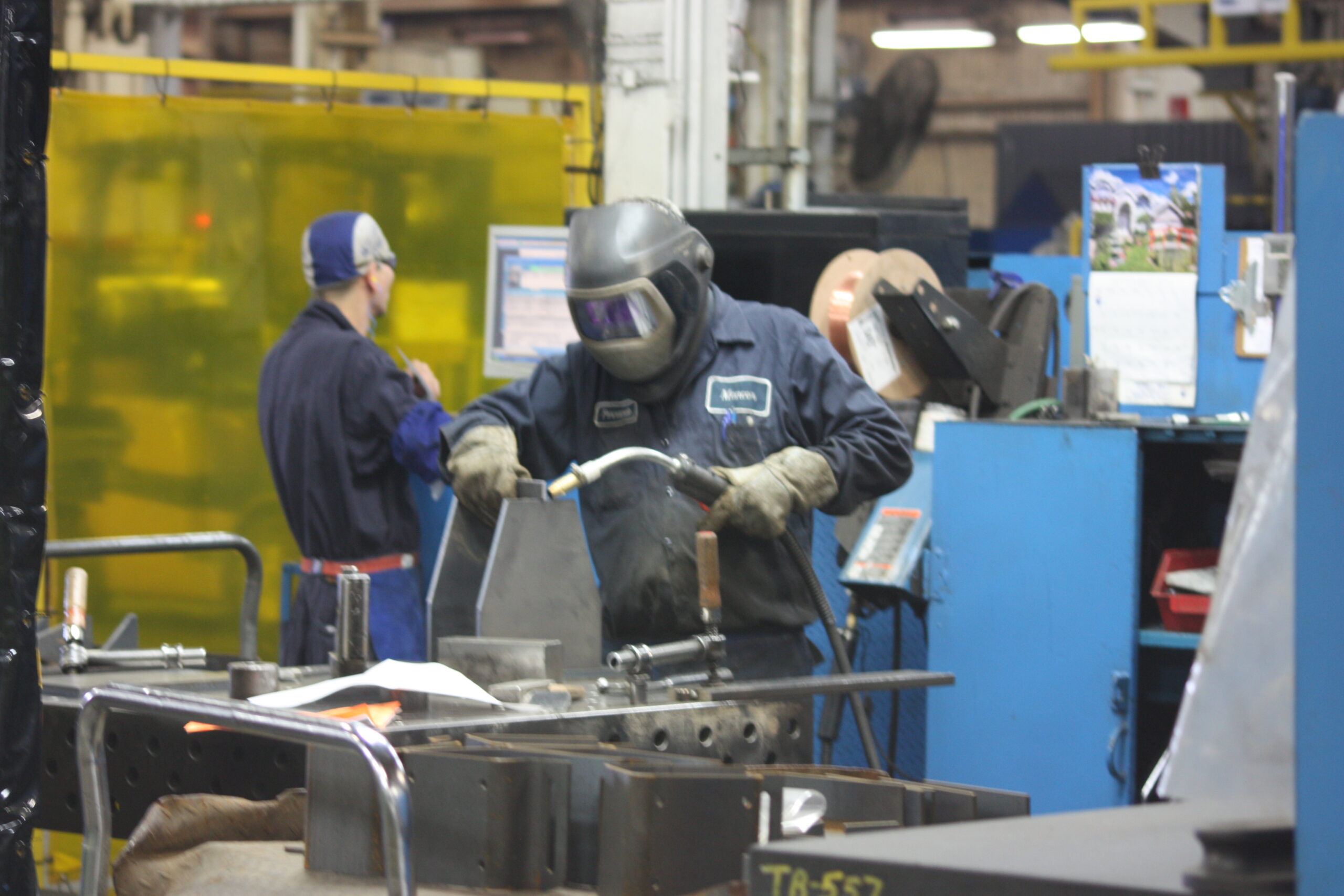
Shop floor execution at the machine: For a repetitive manufacturer, the shop floor is where margin is won or lost. Yield variance on a high-run part, changeover time that runs longer than scheduled, scrap logged hours after it happened; these are the gaps that compound across thousands of cycles and never show up until the margin report does. OnRamp puts line-side monitors at each work center. Operators see current work instructions, run quantities, and quality requirements on the monitor in front of them. They report completions, flag issues, and log scrap directly at the machine, in real time. That data flows back into scheduling, inventory, and job costing immediately. No paper. No end-of-shift data entry. No separate manufacturing execution system to license, configure, or maintain. For shops evaluating standalone MES solutions, OnRamp covers that ground without adding another vendor to manage. Read more about the value of ERP + MES native integration.
Customer-supplied materials, fully tracked: Customer-owned material is received, tracked, and tied to the right jobs throughout production. No separate spreadsheet. No guessing what arrived with which order. Read more about our tailored customer-supplied materials solution.
Quality and traceability built in: Lot tracking, in-process quality checks, and non-conformance records live in the same place as the order and the shipment. When a customer asks for traceability documentation, you pull it rather than reconstruct it.
Accounting that moves with production: When a job ships, the financials move with it. No manual export. No end-of-month reconciliation. Job costing reflects actual labor and material, not standard estimates. For customers requiring EDI, OnRamp handles inbound and outbound transactions without third-party middleware.
One Solution, Not Five Tools Stitched Together.
Most fab shops arrive at OnRamp already running some version of ERP or a patchwork of tools. The problem is rarely the software in isolation. Scheduling does not talk to inventory. Inventory does not talk to the shop floor. The shop floor does not talk to accounting. Every update requires a manual step, and every manual step introduces lag and error.
Some vendors call this “integrated” and mean they have built an API connection between products acquired from different companies. The data syncs on a schedule. The modules look different from each other. Support bounces between teams. You manage the gaps.
OnRamp is natively integrated. Manufacturing, inventory, MRP, quality, maintenance, sales, shipping, and accounting are all built on the same codebase and the same data model. There is no sync job running in the background. There is no middleware connecting a scheduling tool to an inventory tool. When a work order is created, scheduling, inventory, and purchasing all see it at the same moment because they are all reading the same record.
For a fab shop running make-to-order jobs with tight delivery windows, that is not a technical distinction. It is the difference between a floor running on current information and one running a day behind.
The same applies to shop floor execution. Most fabricated metals shops either have no MES layer or are running one disconnected from their ERP. Operators work from paper travelers or verbal instructions. Completions and scrap get entered hours later, if at all. By the time that data reaches scheduling or inventory, it is stale. OnRamp closes that gap with line-side monitors that feed live data directly into the ERP. There is no separate MES to sync, no middleware to maintain, and no lag between what happens on the floor and what the rest of the business sees.
What Fabricated Metals Manufacturers Say After Go-Live
“Our favourite part of the solution is the detailed capacity planning module, which is the best we have ever used and ever want to use.”
Jeff Collis, Operations Manager, Formex Metal Industries
With the OnRamp Detailed Capacity Planning (DCP) module, Formex plans capacity out over a 10 week horizon using integrated customer demand and resource requirements data to plan manpower on a work center basis for each individual day. They estimate it now saves them hundreds of thousands of dollars per year.
“Doubling the company, expanding into new countries and new markets, we couldn’t have done that without OnRamp.”
Malachi Lodder, Senior Project Manager, Genesis Metalworks
Genesis uses OnRamp and the data they get out to constantly search for efficiencies and opportunities to increase capacity. They’ve since scaled into a new facility and opened a new operation in Charlotte, NC.
100% of OnRamp customers achieve their business goals within 12 months of go-live. We have never lost a customer.
The Right Fit for OnRamp
OnRamp was built inside Mancor, a fabricated metals manufacturer running high-volume, repetitive production for major OEM customers including Mack, Volvo, Cummins, and PACCAR. That is not a marketing origin story. It means OnRamp was designed from the start to do what repetitive manufacturers actually need: track yield and run rate at the machine, surface margin erosion before it compounds, and give ops leaders the data to continuously improve capacity on the same parts they run every week.
OnRamp fits best in North American fabricated metals manufacturers with 20 to 150 employees. Tier 1 and tier 2 automotive and industrial suppliers running high-volume releases against blanket purchase orders are a particularly strong fit. So are shops running a mix of repetitive work and make-to-order jobs. If you are managing multiple work centers, tracking customer-supplied materials, facing traceability requirements from OEM customers, or running EDI with your customers, you are in the right place. OnRamp handles inbound and outbound EDI natively, without third-party middleware.
The buyers who get the most out of OnRamp are ops leaders, production managers, and plant managers who are tired of running the shop off spreadsheets, paper travelers, and one person’s institutional knowledge. They want a shop floor that gives real answers, not estimates. It’s for CFO’s and controllers sick of chasing shipping documents and wondering why their time-to-cash metrics never improve. It’s for owners who want to move beyond reactive problem solving, expand their margins, and grow their businesses.
Running a Fabricated Metals Shop: What Good Operations Look Like
The sections below are written for fabricated metals operators still figuring out what the right solution looks like for their shop. If you are earlier in that process, start here.
ERP for Repetitive Manufacturers: Why Standard Job Shop Software Falls Short
Most ERP solutions for fabricated metals manufacturers are designed around the job shop model: quote a job, build a work order, ship it, invoice it. That flow works for make-to-order work. It does not work well for a tier 1 or tier 2 supplier running high-volume releases against a blanket purchase order from a customer like an automotive OEM.
In a repetitive manufacturing environment, the questions that matter are different. What is the yield on this part number across the last 30 runs? Where is changeover time running long and why? What is the true cost per piece once scrap and rework are included? Is the line running at rate, and if not, where is the constraint? Standard job shop ERP does not answer those questions. It tracks orders and inventory. It does not track the production efficiency that drives margin on parts you run every week.
Repetitive manufacturers need ERP that surfaces this data at the machine in real time, feeds it back into planning and costing, and gives leadership visibility into where efficiency is being left on the floor. The goal is not to run the shop. It is to continuously improve it on the same parts, for the same customers, over years of production.
OnRamp was built for this context. The line-side monitor layer, real-time scrap and yield tracking, and job costing built from actual production history are designed for manufacturers who need to find margin in repetitive work, not manage individual jobs in isolation.
Fabrication Shop Scheduling: Why It Keeps Breaking
In most fab shops, the production schedule works fine until it does not. A hot job arrives. A machine goes down. A supplier delivers late. Any one of those events is enough to make the schedule useless, and when the schedule is useless, the supervisor becomes the schedule.
The underlying problem is not the events themselves. It is that most fabrication shop scheduling tools are disconnected from real floor data. The schedule lives in a spreadsheet or a standalone tool with no visibility into what is running, what has been completed, or where material is sitting. When something changes, someone updates it manually. By the time the update gets made, the floor has already moved on.
Scheduling in a fab shop works when three things are true. The schedule reflects real capacity by work center, not theoretical capacity. WIP status updates as jobs move through operations. When a hot job arrives, the impact on everything else is visible before the decision gets made, not after.
OnRamp connects fabrication shop scheduling directly to live floor data. When an operator completes an operation, the schedule updates. When a new order arrives, you see where it fits and what it displaces.
Read More: How to Choose a Metalworking ERP Solution Without Paying for Mistakes Later
Job Costing for Metal Fabrication: What You Need Before You Quote
Most fab shops quote from experience. An estimator who has been doing the job for ten years carries routing times, labor rates, and material costs in their head. That works until it does not. Labor rates change. Material prices move. A process takes three hours now instead of two because the setup was never formally documented.
The result is margin erosion on repeat jobs. A job gets quoted the same way it was quoted two years ago, but the actual costs have shifted. The job ships, the invoice goes out, and the margin shows up in the accounting report weeks later, smaller than expected.
Accurate job costing for metal fabrication requires three inputs: actual labor rates by operation, current material costs, and routing times built from real production history rather than estimates. When those inputs are reliable, quotes reflect what jobs actually cost to run.
OnRamp captures labor, material, and routing data from actual production and feeds it back into future quotes, so estimators work from what the shop has done rather than what they remember.
Inventory Management in a Fab Shop: Why the Numbers Never Match
Inventory accuracy in a fabricated metals shop is harder than it looks. Raw material comes in against purchase orders. Remnant stock gets set aside after cutting and rarely makes it back into the count. Customer-supplied material sits in a corner with a sticky note. Scrap gets logged at end of shift, if it gets logged at all. By the time someone runs a count, the number in the ERP and the number on the floor have diverged.
The downstream effects are real. MRP runs against inaccurate counts and generates the wrong purchase orders. Production pulls material the system says is available and finds it is not. Purchasing expedites orders for material already on the floor under a different label.
Accurate inventory management in metal fabrication requires tracking material at every movement: receipt, transfer, issuance to a job, scrap, and remnant return. It requires that data to come from the floor in real time, not from a paper log entered at the end of the day.
OnRamp tracks material through every step of production in real time. Remnants, customer-supplied stock, and scrap are all captured at the point of work, so the inventory count reflects what is on the floor.
Read More: Sheet Metal Cutting Optimization for Lower Scrap and Better Margins
MRP for Fabricated Metals: When It Works and When It Does Not
Material requirements planning works on a simple premise: if you know what you need to build, when you need to build it, and what material you have on hand, you know what to buy and when. The logic is sound. The problem is the inputs.
In a fabricated metals shop running MRP off unreliable inventory counts, inaccurate routings, or BOMs built from memory, the output is equally unreliable. MRP tells you to buy material you already have. It does not trigger a purchase order for material you need because a scrap event never got logged. Planners learn to distrust it and start overriding manually, which defeats the purpose.
MRP works in fab shops when the floor data feeding it is current and accurate. That means inventory counts updated in real time, scrap logged at the point of work, and routings built from actual production history. When those inputs are clean, MRP runs accurately and planners stop managing exceptions by hand.
OnRamp feeds MRP from live floor data. Inventory moves, scrap events, and job completions all update immediately, so the planning engine works from what is happening in the shop.
Read More: Job Shop ERP Software: Why Native Integration Is the Only Integration That Works
Ready to See OnRamp in a Fabricated Metals Shop?
Choose where you are in the process:
Request a demo. See how OnRamp handles fabrication shop scheduling, inventory management, shop floor execution, and job costing. No canned presentation. We run it against your actual operation.
Download: Fabricated Metals ERP Readiness Checklist. Not ready to talk yet? Use this checklist to identify where your current operation has gaps before you evaluate any metal fabrication ERP.
Read the Genesis Metalworks Case Study. See how a fabricated metals manufacturer like yours made the switch and what changed in the first 90 days.
Additional Insights


