
Author: Andrew Jolliffe in: MES
Painting and Coating
In my post last week, I covered why ERP alone isn’t enough to run a finishing shop floor and what a native shop floor execution layer actually looks like in practice. Live work instructions at every station. Real-time schedule updates. Data that flows from the floor back into the system without manual entry after the shift.
That post was about closing the gap between what the office knows and what the floor is doing. This post is about what becomes possible once that gap is closed: paint line capacity optimization.
When your floor is connected to your ERP in real time, you’re no longer just managing what you know. You’re collecting data about how your operation actually runs, continuously, at every station, on every shift. And that data starts answering questions about paint line capacity optimization that you’ve never been able to ask before.
Questions like: how efficiently is your line actually running? Not in terms of throughput relative to the schedule. In terms of how much of your line’s physical capacity is being used on every pass through the oven.
For most finishing shops, the answer to that question is surprising.
When a finishing shop starts hitting capacity limits, the automatic assumption is that additional capacity requires more equipment, a longer conveyor, or a second line. Nobody even questions whether the line is running at or near its physical limit. If there are any discussions about efficiency, they are focused on the traditional low-hanging fruit. Then the conversation immediately moves on to growing throughput by adding capital.
The assumption that capital is the answer is almost never tested against data. It’s based on the observable fact that the line is always running and production is always behind. If the line is always running and we’re still behind, the logic goes, we must need more line.
But there’s a variable that almost no finishing shop measures: how efficiently the hooks are being loaded.
Hook loading in most finishing shops is done by experienced operators working from habit and intuition. They’ve been hanging parts for years and they have a feel for how to load efficiently. They’re good at it! Most of the time, anyway, on the parts they know well.
What they don’t have is an objective measurement of how much free space is going through the oven on every cycle. How much of the available hook area is actually being used versus how much is empty space that’s consuming energy, taking up oven time, and moving through the line without producing anything.
That free space is invisible capacity. And in most finishing shops, it’s substantial.
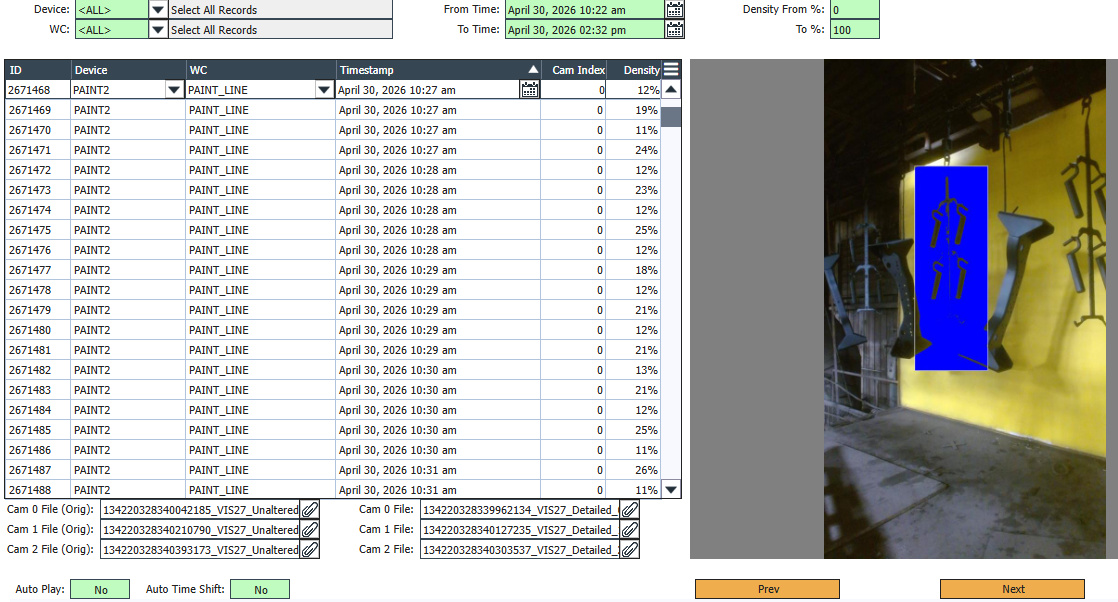
OnRamp’s hook density measurement system uses a camera positioned at the loading station to analyze how parts are being hung on each hook as they move through the line.
The analysis is straightforward. For each hook, the system measures the ratio of filled space to free space within the two-dimensional area around it. It identifies where parts are clustered, where space is being wasted, and how the loading pattern compares to the optimal configuration for that specific part geometry and hook type.
That analysis feeds two things simultaneously.
The operator at the loading station gets real-time feedback on how to hang parts more efficiently. Not a general instruction to load more densely, but specific guidance for the job in front of them, updated as each hook goes by. The work instruction on the line-side monitor shows the optimal hanging configuration so the operator knows exactly how to maximize the hook before it moves down the line.
The system accumulates density data across every shift, every job, and every operator. Over time that data shows patterns: which jobs consistently leave free space on the hook, which operators load more efficiently than others, which parts benefit most from configuration changes, which shifts are running below average density and why.
That’s not just a production insight. It’s a capital planning tool.
A high-volume automotive finishing shop was running a paint line at what felt like capacity. The line was always moving. Production was consistently behind demand. Leadership had begun planning a significant capital investment in a second paint line to meet growing customer commitments.
Before committing to that investment, they ran OnRamp’s hook density analysis on their existing line.
The result: 30% more capacity was already there.
The line wasn’t at its physical limit. The hooks weren’t being loaded efficiently enough to get close to it. Free space was moving through the oven on every cycle, consuming energy and line time without producing anything. The constraint wasn’t the line. It was the loading pattern.
With hook density guidance at the loading station, operators began hanging parts more efficiently on every pass. Throughput increased. The backlog cleared. The second paint line never got built.
The capital investment that was being planned to solve a capacity problem turned out to be a solution to a measurement problem. The capacity was there the whole time. Nobody had a way to see it.
Hook density measurement is a finishing-shop-specific capability. But the underlying principle extends across the entire operation.
When your shop floor execution layer is native to your ERP, the data it collects isn’t just operational. It’s analytical. Every event at every station, every operator input, every machine signal, every hook that goes through the line, all of it accumulates in the same system that manages your schedule, your job costs, your quality records, and your financials.
That data doesn’t just tell you what happened. Over time it tells you how efficiently things happened, where the patterns are, and where the hidden capacity or hidden cost is sitting in your operation.
Most finishing shops are making capital and operational decisions based on observable symptoms: the line is always running, production is always behind, rework keeps happening. Those symptoms are real. But the root cause isn’t always what it appears to be.
A shop floor intelligence layer gives you the data to find the root cause before you spend money solving the wrong problem.
The most expensive assumption in a finishing shop is that a capacity problem requires a capital solution.
Sometimes it does. But before you commit to a new line, a longer conveyor, or an additional shift, it’s worth knowing how much capacity you already have and whether you’re using it.
OnRamp’s hook density measurement system, combined with the native shop floor execution layer we covered in our last post, gives finishing shops a way to answer that question with real data rather than intuition.
If your finishing shop is running at what feels like capacity and growth is starting to require capital investment, we’d like to show you what the data actually says about your line before you break ground.

For more information about how OnRamp ERP software can add value to your business fill in the contact form below. A member of our support team will contact you within 1 business day to discuss any questions you have.
Start the collaboration with us while figuring out the best solution based on your needs.


Our efforts began as an internal project of Mancor Industries when we identified the need for a more cohesive ERP system to manage the complexity of multiple plants, multiple products, multiple customers and multiple functions.
Read MoreHas your business outgrown a patchwork of disconnected systems? This checklist helps you assess readiness, identify gaps, and prepare for a smooth transition.


