
Author: Ian Church in: Planning
Manufacturing quoting fails for a simple reason: estimating relies on assumptions instead of finished job results. Early on, experience fills the gaps. As volume grows or job mix shifts, those gaps widen. Margins erode. Confidence drops.
This problem rarely comes from poor judgment. It comes from missing feedback. When estimating never reconnects with completed work, pricing drifts away from reality. Growth exposes the issue, but by that time your margins have begun to erode and applying a solution becomes a big challenge.
Fixing quoting starts with understanding where estimating breaks down and how real job data changes the outcome.
Estimating issues follow predictable patterns across job shops, coating operations, and foundries. Information exists, but it stays scattered or outdated. Over time, teams rely more on habit than evidence.
Labor estimates often come from memory instead of recorded time. Production steps blur together without clear visibility into setup, run, inspection, rework, or field work. Material costs pull from old pricing or incomplete usage data. Scheduling tools force work into fixed increments even when jobs vary by minutes or hours. After jobs close, teams move on without reviewing results.
Each issue introduces uncertainty. Together, they turn quoting into a gamble rather than a process grounded in facts.
Spreadsheets feel flexible early. Estimating teams adapt quickly and move fast. As volume increases, control fades. Versions multiply. Errors slip through unnoticed. Manual updates consume time and attention.
Rigid ERPs introduce structure but often fail to reflect real workflows. Estimating lives in one place. Production data lives elsewhere. Labor tracking sits outside both. Inventory updates lag behind actual usage. Job history stays disconnected from future quotes.
These tools focus on planning. They fall short when outcomes matter more than intent.
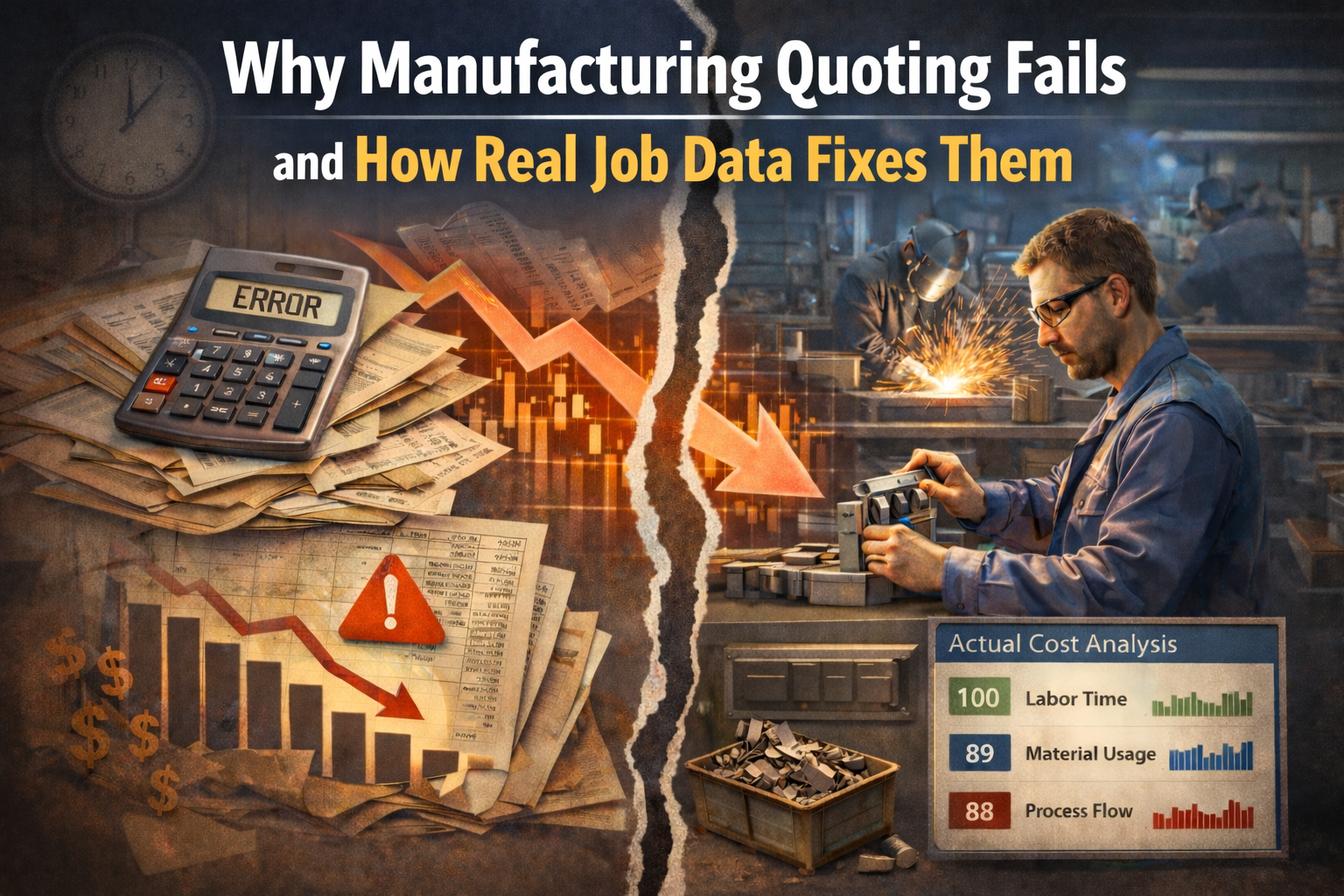
Strong estimates grow from finished work. Actual results replace assumptions over time. This shift changes how teams think about quoting. Instead of asking what a job should cost, estimators review what similar jobs actually required.
Three inputs drive accurate estimates.
Actual labor time
Labor time matters most when captured at the operation level. Setup, run, inspection, rework, and field work deserve separate tracking. Granularity reveals patterns experience alone misses.
Actual material usage
Issued material, scrap, and returns tell a clearer cost story than standards. Purchasing prices fluctuate. Usage varies. Real data reflects both.
Actual process flow
Each step in sequence shapes cost and lead time. Waiting, handoffs, and off-site work influence margin as much as machine time.
When these inputs stay tied to the job record, estimating improves with every completed order.
Better estimates do not require a new philosophy. Discipline matters more than theory. A simple feedback loop keeps quoting grounded in reality.
Start by closing every job with a review. Compare estimated and actual labor, material, and time before billing. Patterns surface quickly when teams look consistently.
Next, store results in one place. Job history needs to live where estimators already work. Separate systems slow learning and encourage shortcuts.
Then, reference similar jobs during quoting. Finished work provides a baseline. Scope differences guide adjustments rather than guesswork.
Finally, update standards on a routine schedule. Labor rates, scrap assumptions, and routing times drift without attention. Regular updates keep estimates aligned with shop conditions.
This loop turns experience into usable data instead of tribal knowledge.
Labor drives most estimating error. Small misses compound across jobs and weeks. Without clear records, teams underestimate setup, overlook rework, or ignore field time.
Effective labor tracking shares common traits. Time captures at the operation level. Technicians use simple entry screens. Start and stop events remain clear. Manual correction stays minimal.
When labor data flows directly into job costing, estimates reflect how work runs instead of how teams remember it.
Estimating depends on throughput assumptions. Scheduling tools shape those assumptions every day. When planning fails to match reality, quotes suffer.
Problems arise when systems enforce fixed daily lead times, separate calendars by product or employee, or prevent overlapping operations. Capacity constraints disappear from planning. Estimates rely on averages instead of flow.
Real jobs vary by minutes, hours, and days. Estimating improves when scheduling reflects actual capacity and sequence rather than calendar blocks.
Coatings and linings operations face wide variability. Surface prep, cure time, field work, and rework drive cost. Tracking each phase clarifies where estimates drift and where margins hold. Finished jobs reveal repeatable patterns teams rarely see during quoting.
Foundries face similar challenges. Melt time, mold prep, finishing, and heat tracking vary by part. Linking heats to job costs exposes true drivers of margin. Repeat work becomes easier to price with confidence.
Different industries share the same lesson. Finished jobs teach more than assumptions.
Specialized quoting software can be powerful, but only if they are using real job data to inform future estimates. OnRamp connects quoting directly to job history, labor tracking, inventory, and scheduling. Estimates improve as work completes because real operational data feeds the next quote. One record follows the job from quote through close. Labor, material, and process data stay connected. Estimators reference finished work without leaving their workflow.
Quoting becomes a process built on evidence rather than memory.

For more information about how OnRamp ERP software can add value to your business fill in the contact form below. A member of our support team will contact you within 1 business day to discuss any questions you have.
Start the collaboration with us while figuring out the best solution based on your needs.


Our efforts began as an internal project of Mancor Industries when we identified the need for a more cohesive ERP system to manage the complexity of multiple plants, multiple products, multiple customers and multiple functions.
Read MoreHas your business outgrown a patchwork of disconnected systems? This checklist helps you assess readiness, identify gaps, and prepare for a smooth transition.


